
How Modular Buildings Support AI-Driven Data Center Construction
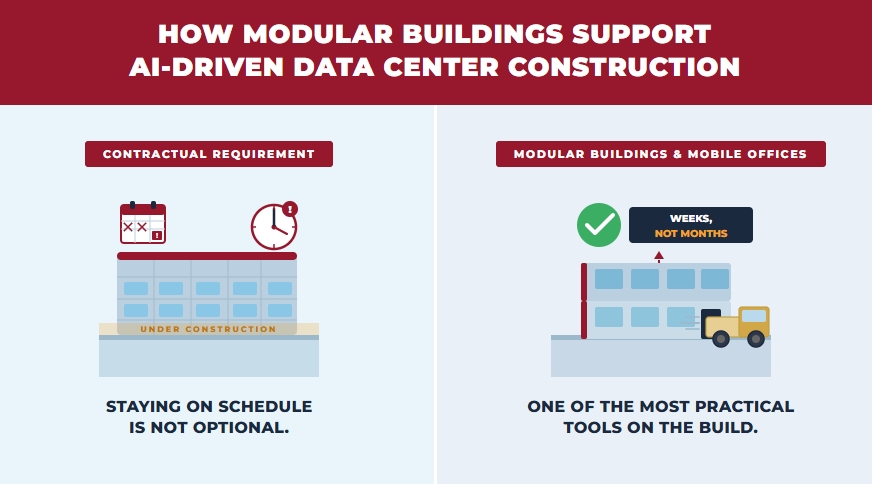
The AI boom has put data center construction under a level of pressure the industry has rarely seen. Hyperscale operators are racing to bring capacity online, and the schedules behind those facilities leave almost no room for error. For the general contractors, project managers, and commissioning teams on these builds, staying on schedule is not a competitive advantage — it is a contractual requirement.
Modular buildings and mobile offices are one of the most practical tools available for keeping these projects on track. Here is what construction teams need to understand.
Why Deadlines Are Non-Negotiable
Data center projects run on tightly compressed timelines. Operators commit to go-live dates months or years in advance, and those dates are tied to customer contracts, cloud capacity commitments, and infrastructure dependencies that cannot simply absorb a delay. Even a few weeks of slippage can trigger penalty clauses or push back a client’s broader operational plans.
The coordination demands on these sites are also unusually high. Electrical contractors, mechanical crews, network infrastructure specialists, and commissioning agents all work in close sequence. Keeping everyone aligned requires a professional on-site presence from day one — not a temporary tent or a project manager working out of a truck.
Common Causes of Delays
Understanding where projects lose time is the first step to preventing them. On data center builds, delays tend to come from predictable places:
- Communication gaps between trades. Without a central on-site workspace, decision-making slows and small miscommunications become costly problems.
- Inadequate space for planning and documentation. These projects generate significant technical documentation — blueprints, single-line diagrams, commissioning checklists, and compliance records. Teams that lack a dedicated space to manage that material spend time recovering from errors that better-organized teams catch early.
- Vendor and inspection coordination. Third-party commissioning agents, utility representatives, and equipment vendors need a professional environment to work in. Without one, scheduling those touchpoints becomes complicated.
- Weather and site exposure. Teams that lack a climate-controlled workspace lose productive hours during weather events — hours that compound quickly on a build with a hard deadline.
How Modular Buildings Reduce Bottlenecks
A well-placed modular building solves most of these problems before they start.
Getting a functional workspace on-site early is one of the highest-impact decisions a project team can make. Starting your mobile office project as early as possible supports better planning from day one, before coordination gaps have a chance to develop.
Modular buildings and mobile offices can be delivered and operational in days, not months — a meaningful advantage when schedules are already aggressive. For large data center projects that expand as they progress, s-plex modular complexes offer the ability to scale workspace up as crew size and trade activity increase, without disrupting ongoing work.
For projects with teams spread across a large site, skid offices provide a flexible option that can be repositioned as work areas shift — keeping project leadership close to where the action is at every phase of the build.
Key Features That Support High-Tech Builds
For data center construction, the right unit should include:
- Robust electrical capacity to support workstations, monitors, and communication tools throughout the day
- HVAC systems that keep the team productive regardless of outdoor conditions
- Adequate square footage for the crew size — from a compact unit for a small site team to a multi-room complex for a large GC with multiple trade partners
- Security features, including lockable doors, secure windows, and proper exterior lighting, to protect sensitive project documentation and equipment
- Conference and meeting space for daily standups, subcontractor check-ins, and client walkthroughs
- ADA accessibility for sites hosting inspectors, commissioning agents, or client representatives
Ready-to-Go Furniture Packages make it easy to outfit a unit with everything the team needs — from workstations and plan tables to breakroom setups — without sourcing furniture separately.
Who Benefits Most
The advantages of a well-equipped on-site workspace extend across every role on the project.
- General contractors gain a centralized command center for scheduling, documentation, and daily trade coordination.
- Engineers and technical staff have a focused environment to review plans, run calculations, and problem-solve with fewer distractions.
- Specialty trade contractors can work in organized, trade-specific spaces instead of sharing overcrowded facilities.
- Commissioning teams, who often arrive when schedule pressure is highest, can get to work immediately when a professional workspace is already in place.
Build Smarter from Day One
The construction teams that keep data center projects on schedule treat site infrastructure as a priority, not an afterthought. Satellite Shelters works with tech and data-sector construction teams to deliver the right solution before work begins. Browse our available inventory or contact a local Satellite Shelters branch to discuss your project timeline and site requirements.